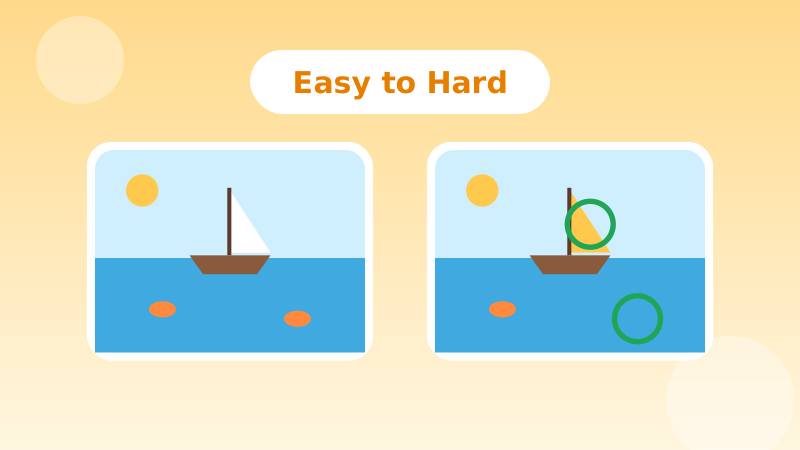
Not all differences are created equal. Some leap out the moment the level loads; others stay hidden until the timer is nearly gone. After making and playing a lot of puzzles, we've noticed that difficulty depends mostly on what kind of change it is and where it sits in the picture. Here are the main types of difference, roughly from easiest to hardest, with tips for catching each one.
1 A big object disappears
Difficulty: easy. A tree, a car, a person or a large sign that is in one picture and missing from the other usually stands out quickly, especially if it was near the centre of the scene. Our eyes are drawn to large shapes and to the middle of an image, so these are often the first ones found.
How to catch it: take a two-second look at both whole pictures before searching in detail.
2 A large colour change
Difficulty: easy to medium. A red car turning blue or a yellow house turning green is obvious if the object is big and the colours are very different. It gets harder when the new colour is close to the old one (orange to red), or when the colour change is on something we don't usually pay attention to, like a wall.
How to catch it: do one pass where you ignore shapes completely and look only at colour.
3 Something new appears
Difficulty: medium. You might think an added object is as easy as a missing one, but in practice additions are often harder. A bird added to a busy sky or an extra flower in a garden fits right in, so your brain accepts it as part of the scene.
How to catch it: look at empty spaces such as the sky, a plain wall or a table top. New objects love empty space.
4 Size and shape changes
Difficulty: medium. A longer tail, a taller chimney, a rounder window, a shorter shadow. The object is still there and still the same colour, so it passes a quick check. These changes are easiest to see where the altered object lines up with something else, like the top of a door with a window frame.
How to catch it: compare edges and alignments. Does the top of the lamp still touch the shelf above it?
5 Counting changes
Difficulty: medium to hard. Four buttons instead of five, one fewer stripe on a flag, a missing fence post. Our brains store groups of similar things as "some buttons" or "a fence", not as a number. Unless you count, you'll rarely notice.
How to catch it: whenever you see repeated items, count them in both pictures. It takes seconds and catches a lot.
6 Moved or flipped objects
Difficulty: hard. A picture on the wall shifted a little to the left, a cat facing the other way, a clock with its hands in different positions. Everything that should be in the scene still is, so a quick check of "is everything there?" says yes.
How to catch it: use landmarks. Note what each object sits next to, and check that relationship in the other picture.
7 Pattern and texture changes
Difficulty: hard. A missing tile in a floor, a spot on a dog that became a stripe, one brick a slightly different shade. Patterns are processed as a texture, a single "brick wall", so a small change inside the pattern can be almost invisible.
How to catch it: look for the place where the rhythm of the pattern breaks. Defocus your eyes slightly and scan along the rows.
8 Tiny details on small objects
Difficulty: very hard. A missing earring, a different letter on a sign, the expression on a small face, a button on a sleeve. Tiny details are seen sharply only when you look directly at them, so you have to actually visit each one.
How to catch it: save these for last. When only one or two differences remain, slowly check faces, hands, text and jewellery.
9 Changes in "boring" areas
Difficulty: very hard. A cloud removed from the sky, a crack added to the pavement, a patch of grass in a new shade. These are the classic final differences, because the brain treats background areas as not worth remembering. It's a key part of change blindness.
How to catch it: deliberately check edges, corners and background. If you're stuck, this is where to look.
Putting it together: a search order
Based on the types above, here's a simple order that works for most puzzles:
- Quick glance at both whole pictures for big missing objects and big colour changes.
- Grid search, one section at a time, comparing objects and shapes.
- Count any repeated items.
- Colour pass, looking only at colours.
- Background pass, checking edges, sky, floor and walls.
- Detail pass on faces, hands, text and small objects.
You won't need every step for every puzzle, but when you're stuck, the next step on the list is usually where the missing difference is hiding. For more strategies, read our 10 tips to get better at spot the difference, then put them to the test with a free puzzle.