Most families today are trying to strike a balance with screens. Children love games, parents worry about how much time is too much, and the advice can feel confusing. The good news is that screen time isn't all the same. What children do on a screen, how long they do it and who they do it with matter more than a single number of minutes. Here is a practical, calm approach to fitting puzzle games into a healthy day.
Not all screen time is equal
Researchers and children's health organisations increasingly distinguish between different kinds of screen use. Passive scrolling through endless video is very different from an activity that asks a child to think, solve a problem or create something. Talking to grandparents on a video call is different again. Puzzle games sit in the "active" group: a child has to look, decide and act, and each level has a clear beginning and end.
That said, even good activities can crowd out sleep, outdoor play, reading and time with family if they go on too long. The aim isn't to remove screens, but to keep them in proportion.
What health guidance generally says
Guidance differs a little between countries, but the World Health Organization and many paediatric associations broadly agree on a few points:
- Under 2: little or no recreational screen time, apart from video chatting with family.
- Ages 2 to 5: no more than about an hour a day of good-quality content, ideally watched or played with an adult.
- School-age children and teens: rather than one fixed limit, make sure screens don't replace sleep, physical activity, homework and time with people.
- For everyone: avoid screens in the hour before bed and keep devices out of bedrooms overnight where possible.
These are guidelines, not rules for every situation. Your family doctor or paediatrician is the best person to advise on your child's needs.
What makes a puzzle game a good choice
When choosing games for children, look for:
- Natural stopping points. Short levels make it easy to say "two more levels, then dinner".
- Thinking, not just tapping. The game should reward careful attention, not frantic tapping. In Diffora, wrong taps cost a heart, so guessing doesn't pay.
- Age-appropriate content. Gentle themes, no violence, no chat with strangers.
- Honest design. Be cautious of games that pressure children with constant pop-ups or tricky purchase buttons. Check the store page and privacy policy, and use device parental controls for purchases.
- Something to talk about. Games with pictures and stories give you a way to join in and chat.
Play together when you can
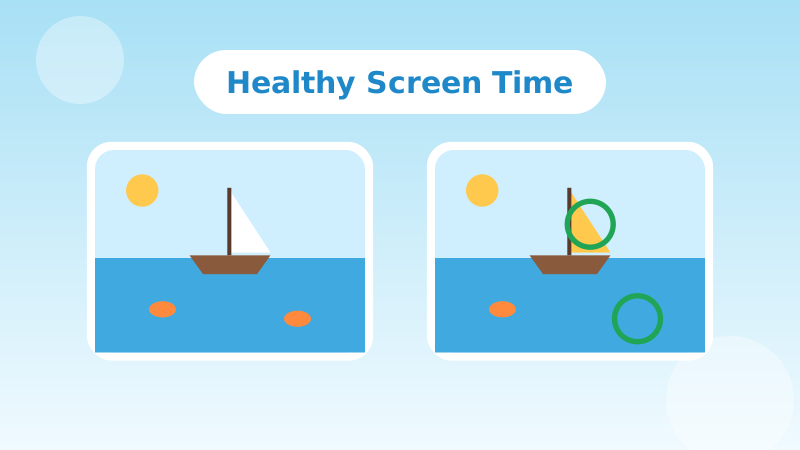
One of the most consistent pieces of advice is to share screen time with younger children. With a spot-the-difference puzzle this is easy: take turns finding differences, ask "what changed?", and talk about how they found it. It turns a solo game into a conversation, builds vocabulary and lets you see exactly what your child is playing. Our article on the benefits of spot-the-difference puzzles for kids has more ideas for making play sessions count.
Practical routines that work
- Set the limit before starting. "You can play three levels" works better than stopping a child mid-game.
- Use a visual timer for younger children so the end doesn't come as a surprise.
- Make screens a part of the day, not the default. A puzzle after homework or while waiting for an appointment, rather than whenever there is a quiet moment.
- Create screen-free zones, such as the dinner table and bedrooms.
- Balance with movement. After a puzzle session, go for a walk and play a real-world "spot what changed" game in the park or street.
- Model it yourself. Children notice how adults use their phones.
Settings worth checking
- Purchase controls: both iPhone/iPad (Screen Time) and Android (Family Link and Google Play settings) let you require approval for purchases.
- App time limits: you can set daily limits for specific apps or categories.
- Notifications: turn off game notifications on a child's device if they're distracting.
- Downtime: schedule hours when only essential apps are available, such as overnight.
Offline alternatives
The skills in a spot-the-difference game, careful looking, patience and memory, can be practised without any screen. Printed puzzle books, picture books with hidden details, "I spy", jigsaw puzzles and the games in our family spot-the-difference ideas are all great options. Mixing on-screen and off-screen versions keeps things fresh.
The bottom line
A short, focused puzzle game, played with clear limits and ideally together, can be a perfectly healthy part of a child's day. Keep an eye on the bigger picture: plenty of sleep, movement, outdoor time, reading and people. When those are in place, a few levels of spot the difference are just what they should be: fun.