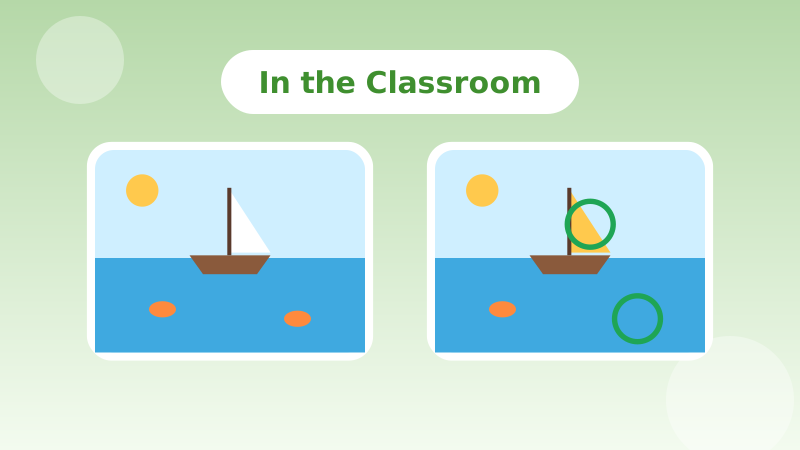
Spot-the-difference puzzles are a quick, flexible tool that fits easily into a school day. They need no reading, they work across languages and ability levels, and they get a whole class looking and talking within seconds. Here are practical ways teachers can use them, from five-minute warm-ups to full lessons in science, language and art.
1 As a calm start to the lesson
Project a puzzle on the board as students come in. They settle, start looking and quietly note how many differences they spot before the lesson begins. It is a gentle way to shift attention from the corridor to the classroom. Give a fixed time, say three minutes, then reveal the answers together.
2 To build descriptive language
Instead of pointing, ask students to describe each difference in a full sentence. This is ideal for practising:
- Comparatives and superlatives: bigger, smaller, the tallest tree.
- Prepositions of place: above, below, next to, behind, between.
- Quantity words: more, fewer, several, none.
- Colour and shape vocabulary for younger learners.
It works especially well in language classes. Pairs can play an "information gap" version where each student has only one of the two pictures and they must find the differences by talking, without looking at each other's sheet.
3 In science: the art of observation
Careful observation is the first skill of any scientist. Spot-the-difference puzzles are a fun lead-in to activities like comparing two leaves, two rock samples, before-and-after photos of a plant experiment, or two pictures of the same habitat in different seasons. Ask students to record differences in a table with columns for feature, picture A and picture B. That is real scientific note-taking.
4 In maths: counting and data
Use scenes with repeated objects and make "count" differences: one fewer apple, an extra window. Younger students count and compare. Older students can tally how many of each type of difference the class found (colour, missing, moved) and draw a bar chart. Which type was hardest to spot? It is a nice, concrete data set.
5 In art: create the puzzle
Students draw an original scene, then create a modified copy with a set number of differences. This requires careful copying, planning and an understanding of composition: where will the eye go first, and where can something hide? Exchange the finished puzzles between classes. Our guide on how to make your own spot-the-difference puzzle has step-by-step instructions you can adapt.
6 To teach thinking strategies
Puzzles are a perfect, low-pressure way to talk about how we think. After a round, ask:
- Which difference did you find first? Why do you think that one stood out?
- Which was the hardest? Where was it?
- Did anyone use a plan, like going top to bottom? Did it help?
Students quickly discover that a systematic search beats random looking, and that the "boring" parts of a picture hide the most. That is a useful lesson about checking work in any subject. Older students might enjoy learning why the brain misses obvious changes.
7 As a brain break or reward
A two-minute puzzle between demanding tasks gives students a change of activity without losing focus completely. It also works as an early-finisher activity: keep a folder of printed puzzles at different difficulty levels for students who complete their work early.
Inclusive tips
- Offer different difficulty levels of the same theme so everyone can join in.
- Make timers optional. Some students find time pressure stressful. Let them work toward a target number instead.
- Consider colour vision. About 1 in 12 boys and 1 in 200 girls have some form of colour vision deficiency. Make sure most differences don't depend only on red and green.
- Allow pair work. Talking through the search helps students who struggle with attention.
- Provide large prints or project on a big screen for students with low vision.
Using Diffora in class
Diffora's online puzzle runs in any modern browser on a laptop, tablet or interactive whiteboard, with no sign-up or account. It shows two pictures, a timer and a set of differences to find, and you can load a new random puzzle at any time. For a whole-class activity, project it on the board and let students take turns coming up to tap a difference. Please note that the free web version may show ads, so preview it on your school network and follow your school's policy on online tools.
However you use them, spot-the-difference puzzles are a small investment of time that gets every student looking closely, thinking about their thinking and, usually, smiling.