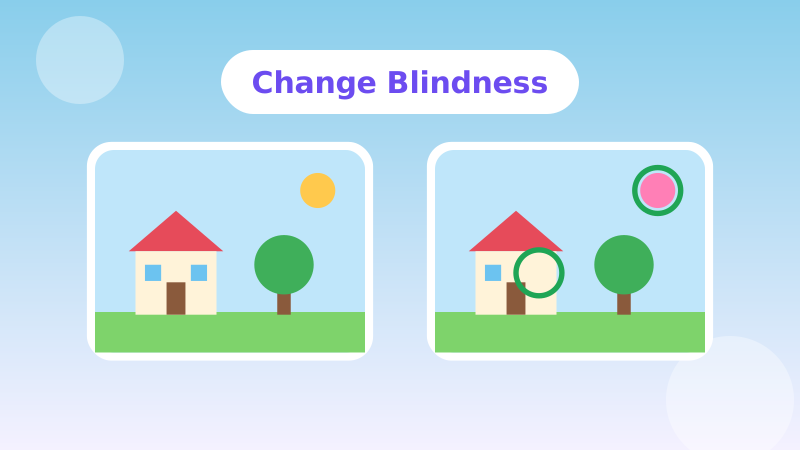
You stare at two pictures for a full minute. You are sure you have checked every corner. Then someone points at the screen and there it is: a lamp post that is missing, right in the middle of the scene. How did you not see it? This doesn't mean your eyesight is bad or you weren't paying attention. Your brain is working exactly as it was built to work. Psychologists call it change blindness, and it is the reason spot-the-difference puzzles are so satisfying and so hard.
What is change blindness?
Change blindness is our surprising failure to notice changes in a scene, even big ones, when the change happens at the same moment as some other visual interruption: a blink, a cut in a film, a flicker on a screen, or simply moving our eyes from one picture to another. When you play spot the difference, your eyes jump back and forth between two images. Every jump is a tiny interruption, and during that interruption your brain doesn't keep a detailed copy of what you were just looking at.
Researchers have studied this for decades. In a well-known set of experiments from the late 1990s, psychologists Ronald Rensink, Kevin O'Regan and James Clark showed people a photograph, then a brief grey screen, then the same photograph with one thing changed, over and over in a loop. This is now called the flicker paradigm. Even when the change was large, such as a whole building disappearing or the colour of a coat switching, many people needed many cycles, sometimes close to a minute, before they spotted it. Without the grey flash, the same change popped out almost at once, because the eye is drawn to motion.
The famous "door" study
Change blindness doesn't only happen on screens. In a study published in 1998, Daniel Simons and Daniel Levin had a researcher stop people on a university campus to ask for directions. In the middle of the conversation, two other people carrying a door walked between them. Behind the door, the person asking for directions was swapped for a different person, someone with different clothes, a different voice and a different height. Roughly half of the people giving directions didn't notice they were now talking to someone else.
This sounds unbelievable until you understand what your brain is really doing. It isn't recording a video. It builds a quick summary of the situation ("a student is asking me the way to the library") and only keeps detail about what it decides is important right now.
Why the brain works this way
It feels like we see the whole world in sharp detail, but that is a clever illusion. Only a small area in the centre of each eye, called the fovea, sees fine detail. Everything else is blurry and low in colour. Your eyes make several quick jumps every second, called saccades, and your brain stitches the results into one smooth picture. To do that without being overwhelmed, it relies heavily on expectations. If you see a kitchen, your brain fills in "kitchen things" and doesn't check each one.
On top of that, our short-term visual memory is small. Studies of visual working memory suggest most adults can hold only around three or four simple objects in mind at once. When you look at the left picture and then the right, you carry over just a handful of details. Anything you didn't actively hold on to is simply gone, and a change there is invisible to you.
Change blindness vs. the "invisible gorilla"
A close cousin of change blindness is inattentional blindness. In the famous 1999 video experiment by Daniel Simons and Christopher Chabris, viewers counting basketball passes often failed to notice a person in a gorilla suit walking right through the scene. The difference is subtle. Inattentional blindness is missing something that is there because your attention is busy elsewhere. Change blindness is failing to notice that something has changed between two views. Spot-the-difference puzzles mainly test the second one, but the two work together. When you are focused on one part of a picture, you are less likely to notice a change somewhere else.
What this means for spot-the-difference puzzles
Once you understand change blindness, a lot about these puzzles starts to make sense:
- Changes in "boring" areas are hardest. Your brain decides that sky, walls and grass are unimportant, so it doesn't store detail there. Puzzle designers know this and often hide differences in exactly those places.
- Colour swaps are sneaky. We tend to remember what an object is far better than what colour it is. A red cup becoming a blue cup is still "a cup", so it slips through.
- Missing objects are easier than moved objects. Something that vanished leaves a gap. Something that shifted slightly still fits your summary of the scene.
- Small, familiar items disappear from memory first. A button, a window, a leaf: your brain stores them as "some buttons", not as an exact number.
How to beat your own brain
You can't switch off change blindness, but you can work around it. The trick is to make your brain store more detail on purpose, a little at a time:
- Compare small areas. Instead of looking at the whole left picture and then the whole right picture, look at one small region, then the same region in the other picture. Your three-or-four-object memory is enough for a small region, but not for a whole scene.
- Name what you see. Quietly say "three windows, red door, two birds". Turning details into words gives your memory a second way to hold them.
- Count repeated things. Counting forces you to look at each item, not just the group.
- Check colours deliberately. Once you have checked shapes, go around again and only look at colours.
- Visit the boring zones. Make a point of checking edges, corners, sky and floor.
We go deeper into these techniques in our guide, 10 tips to get better at spot the difference.
Practice really does help
People who play a lot of spot-the-difference puzzles get noticeably faster, not because their memory grows dramatically, but because they learn better strategies: where to look, how to scan and which tricks designers use. That is a real skill, and it is a fun one to build. The next time a difference seems to be hiding in plain sight, remember that the puzzle is designed to exploit a normal, healthy feature of your brain. Finding it anyway is the win.
Want to see change blindness in action? Try a free puzzle in your browser and notice which differences you find last. They are probably in places your brain decided were not worth remembering.
- Rensink, R. A., O'Regan, J. K., & Clark, J. J. (1997). To see or not to see: The need for attention to perceive changes in scenes. Psychological Science.
- Simons, D. J., & Levin, D. T. (1998). Failure to detect changes to people during a real-world interaction. Psychonomic Bulletin & Review.
- Simons, D. J., & Chabris, C. F. (1999). Gorillas in our midst: Sustained inattentional blindness for dynamic events. Perception.
- Luck, S. J., & Vogel, E. K. (1997). The capacity of visual working memory for features and conjunctions. Nature.