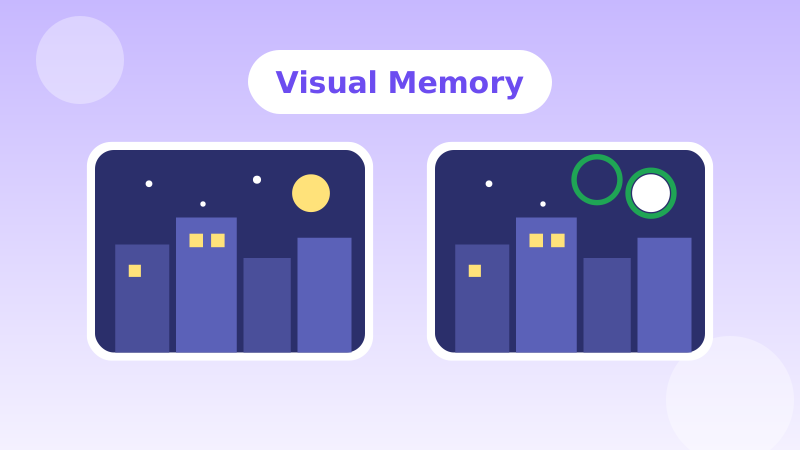
Close your eyes and picture the room you are sitting in. You can probably recall the layout, the big furniture and maybe the colour of the walls. But how many objects are on the nearest shelf? Which way is the mug handle pointing? Most of us have no idea. That gap between what we see and what we can hold on to is visual memory at work, and spot-the-difference puzzles test it constantly.
Three kinds of visual memory
Psychologists usually describe visual memory as several systems working together:
1. Iconic memory: a split-second snapshot
For a fraction of a second after you look away, your brain holds a rich but fragile "afterimage" of the scene. In classic experiments from 1960, psychologist George Sperling flashed grids of letters for a moment and showed that people briefly had access to far more than they could report, but the snapshot faded within a few hundred milliseconds. It is like a camera flash: bright, detailed and gone almost immediately.
2. Visual working memory: the small notepad
What survives is a tiny selection kept in visual working memory, the mental notepad you use to compare, plan and imagine. It is impressively flexible but very small. In an influential 1997 study, Steven Luck and Edward Vogel found that people could reliably hold only about three or four simple coloured shapes in mind at once. Later research suggests the exact limit depends on how complex the objects are and how precise the memory needs to be, but everyone agrees the capacity is limited.
3. Long-term visual memory: surprisingly huge
Long-term visual memory is the opposite: enormous. In one striking experiment, people who were shown thousands of pictures of everyday objects could later pick out which ones they had seen with remarkable accuracy. But long-term memory tends to store the gist (a red bicycle by a wall) rather than every spoke and shadow.
What this has to do with spot the difference
Every time your eyes jump from one picture to the other, the iconic snapshot is gone in a moment. What you carry across is the handful of items in working memory. If you were looking at the whole scene, those three or four items are a tiny fraction of the picture, and any change elsewhere goes unnoticed. This is the core of change blindness.
It also explains why some strategies work so well. Comparing a small area means three or four items are enough to cover everything in it. Counting objects turns many items into one number, which is much easier to hold. And naming details in words ("blue door, two windows") uses verbal memory alongside visual memory, giving you a little more room.
Chunking: how experts remember more
Experts in many fields seem to have amazing memories for their subject. Chess masters can glance at a game position and reconstruct it almost perfectly. Yet when the pieces are placed randomly, their advantage largely disappears. What they have isn't a bigger notepad. They have learned to group details into meaningful chunks, and one chunk takes up one slot.
Regular spot-the-difference players do something similar on a small scale. Instead of remembering "a lamp, a table, a book, a cup", they see "the reading corner" and notice when it doesn't look right. They also learn where puzzle designers like to hide changes, so they spend their limited memory on the places most likely to matter.
Can you improve your visual memory?
It depends on what you mean. Research suggests the raw capacity of working memory is hard to expand much with practice, and claims that memory games boost general intelligence haven't held up well. But you can get much better at using visual memory well:
- Strategy: searching in small sections, counting and naming details all help you remember more of what matters.
- Attention: what you deliberately focus on is far more likely to be stored. Distractions eat memory slots.
- Familiarity: the more you practise a type of task, the better you get at chunking its details.
- Rest: sleep plays an important role in consolidating memories, and tired brains notice less.
Try it yourself: three quick experiments
- The coin test. Without looking, try to draw both sides of a common coin from your country. Then compare with a real one. Most people get the details badly wrong despite seeing coins every day. Recognition and recall are very different.
- The shelf test. Look at a shelf for ten seconds, turn away and write down everything on it. Then try again, but this time say each object's name out loud as you look. Most people remember more the second time.
- The puzzle test. Play one online puzzle by looking at the whole picture, and another by checking one small section at a time. Compare how many differences you find, and how quickly.
The takeaway
Visual memory isn't a camera. It is a fast, efficient system that keeps a rough sketch of the world and a few sharp details at a time. Spot-the-difference puzzles are fun precisely because they push against that limit. Knowing how it works lets you play smarter: look at less, more carefully, and let your strategy do the heavy lifting. For more practical techniques, read our 10 tips to get better at spot the difference.
- Sperling, G. (1960). The information available in brief visual presentations. Psychological Monographs.
- Luck, S. J., & Vogel, E. K. (1997). The capacity of visual working memory for features and conjunctions. Nature.
- Brady, T. F., Konkle, T., Alvarez, G. A., & Oliva, A. (2008). Visual long-term memory has a massive storage capacity for object details. PNAS.
- Chase, W. G., & Simon, H. A. (1973). Perception in chess. Cognitive Psychology.