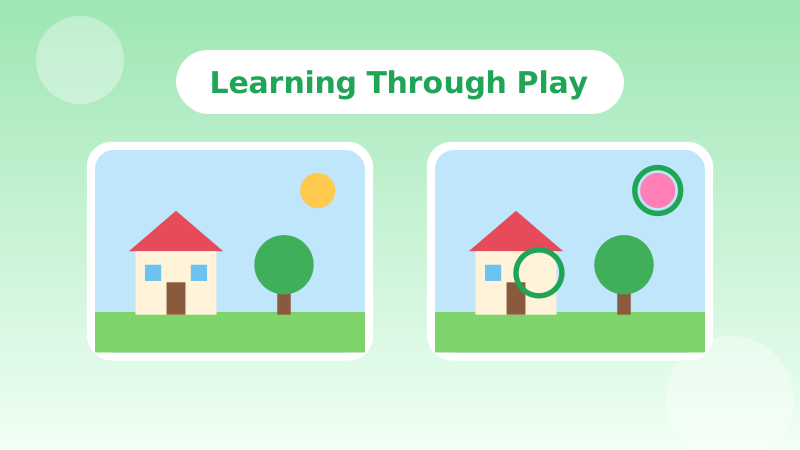
Spot-the-difference puzzles have been a favourite in children's magazines, activity books and restaurant placemats for generations. Kids love them because they are simple to understand: two pictures, find what is different. Parents and teachers like them because, behind the fun, children practise skills they use every day at school. Here is what a child is actually practising when they hunt for differences, and how to match puzzles to their age.
1 Careful looking (visual discrimination)
Visual discrimination is the ability to notice how two things are alike and how they differ. It sounds basic, but it underpins early reading: telling b from d, was from saw, or 6 from 9 is a visual discrimination task. Spot the difference trains exactly this habit of comparing shapes, sizes, positions and colours with care instead of guessing at a glance.
2 Sustained attention
A puzzle with five or seven hidden differences asks a child to keep searching after the easy ones are found. Staying with a task when it gets harder is a skill that develops slowly through childhood. A puzzle gives a gentle, low-stakes way to practise it, with a clear finish line and an immediate reward every time a difference is found.
3 Visual working memory
To compare two pictures, a child has to hold part of one image in mind while looking at the other. That mental "notepad" is called working memory, and it is used constantly in the classroom: copying from the board, following multi-step instructions, doing sums in your head. Comparing pictures doesn't magically expand working memory, but it does give children frequent practice at using it, and at developing strategies, like comparing small sections, that reduce the load.
4 Planning a search
Young children tend to look randomly, jumping to whatever is brightest or most interesting. With practice, they discover that working systematically (top to bottom, left to right, one area at a time) finds more differences. That shift from random to organised searching is an early taste of planning and self-checking, skills that later help with writing, maths and tidying a messy bedroom.
5 Vocabulary and describing
Ask a child to explain each difference and the puzzle becomes a language exercise: "The cat's tail is longer", "There are fewer apples", "The window is above the door now". Comparisons, positions and quantities are core early-years vocabulary, and puzzles give a natural reason to use it.
6 Patience and handling frustration
Every puzzle has a moment where the last difference just won't appear. Learning to take a breath, look in a new place, or ask for a hint instead of giving up is valuable practice in coping with small frustrations. A friendly game with lives and hints, rather than a strict test, keeps that experience positive.
7 Confidence through quick wins
Because each difference found is a small success, puzzles are good at building a child's sense of "I can do this". Finishing a level, earning stars and moving to the next world gives a visible record of progress, which motivates many children far more than being told they are doing well.
Matching puzzles to age
Every child is different, but these rough guidelines help pick the right challenge:
Ages 3 to 5
- Simple, bold pictures with few objects and clear outlines.
- Three to five large differences, such as a missing object or an obvious colour change.
- Play together. Point to an area and ask "Is this the same?" rather than giving the answer.
Ages 6 to 8
- Busier scenes with more objects, and five to seven differences.
- Introduce smaller changes: a stripe on a shirt, the number of petals, a direction an animal is facing.
- Teach the "grid" strategy: check one square of the picture at a time.
Ages 9 and up
- Detailed scenes, subtle colour shifts and objects that have moved slightly.
- A timer adds excitement, but keep it optional for children who find time pressure stressful.
- Challenge them to beat their own score or time, not someone else's.
In Diffora, the Kids worlds use bright, simple scenes for younger players, while the Expert worlds hide smaller, trickier changes, so a family can play side by side at different levels.
A note on "brain training" claims
It is worth being honest: research on brain-training games shows that people reliably get better at the specific tasks they practise, but evidence that this spreads to very different skills, such as school grades or general intelligence, is limited and debated. A large 2016 review led by psychologist Daniel Simons reached that cautious conclusion. Spot-the-difference puzzles are best seen as a fun, healthy way to practise looking carefully, staying focused and being patient, not as a replacement for reading, play, sleep and time outdoors.
Making it a good experience
- Keep sessions short. Ten or fifteen minutes is plenty for young children. Stop while it is still fun.
- Praise the method, not just the result. "You checked every corner, that's why you found it!" teaches the strategy.
- Turn it into conversation. Ask what changed, how they found it, and where they would hide a difference.
- Mix screens and paper. Printed puzzles, picture books and real-life "what changed in this room?" games build the same skills.
- Play together. Taking turns to find differences turns a solo puzzle into a shared activity.
If you want more ideas for offline versions, read our post on spot-the-difference games for the whole family, or try a free puzzle in the browser together.
- Simons, D. J., et al. (2016). Do "brain-training" programs work? Psychological Science in the Public Interest.
- Diamond, A. (2013). Executive functions. Annual Review of Psychology.