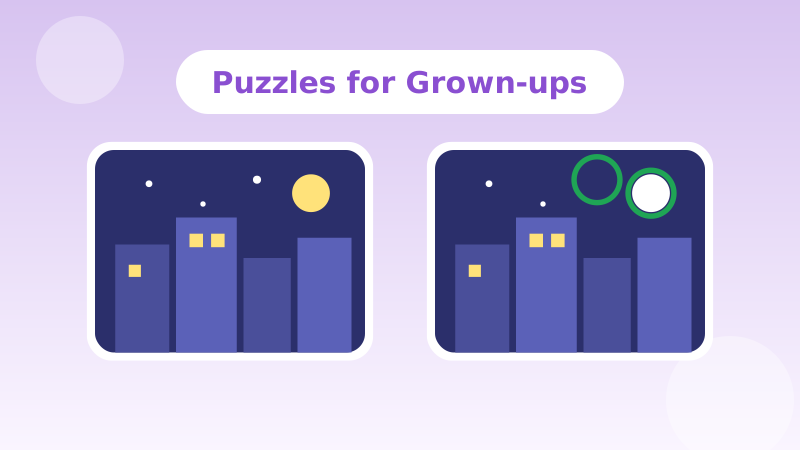
Puzzles aren't just for children. Crosswords, sudoku, jigsaws and spot-the-difference games are enjoyed by millions of adults, and many people find that puzzle time becomes a favourite part of their day as they get older. But what do puzzles actually do for an adult brain? Here is a balanced look at what research suggests, without the hype, and how to make puzzles a rewarding habit.
What the research says (and doesn't)
You have probably seen headlines claiming that a puzzle or game can "keep your brain young". The reality is more nuanced, but still encouraging.
- You get better at what you practise. This is the most solid finding. People who do a type of puzzle regularly become faster and more accurate at it.
- Transfer to other skills is limited. Large reviews of commercial brain-training programs, including a major 2016 review in Psychological Science in the Public Interest, found little convincing evidence that training on games improves very different everyday abilities.
- Some training has shown lasting effects. The long-running ACTIVE study in the United States trained older adults in memory, reasoning or visual processing speed. Benefits on the trained skills were still measurable years later, and the speed training group showed some promising longer-term results.
- Mentally active lifestyles are linked with better ageing. Studies consistently find that people who stay mentally, socially and physically engaged tend to have better cognitive health, though it is hard to prove which activity causes what.
A fair summary: puzzles are a good, enjoyable way to keep your mind active, and they make you better at puzzles. They work best as one part of a healthy lifestyle, not as a medical treatment.
What spot the difference exercises
Compared with word or number puzzles, spot-the-difference games lean on a different set of skills:
- Visual attention: scanning a scene and noticing small details.
- Visual working memory: holding part of one picture in mind while checking the other. We explain this in our article on visual memory.
- Processing speed: when there's a timer, you have to make quick decisions.
- Sustained focus: staying with the task until the last difference is found.
That makes spot the difference a nice complement to crosswords and number puzzles. Variety is good: trying different kinds of puzzles keeps them challenging and stops any one from becoming automatic.
The underrated benefit: relaxation
Many adults say they play puzzle games to unwind. A spot-the-difference puzzle asks you to slow down and look carefully at one thing, which can be a welcome break from the multitasking of daily life. Some people describe it as a gentle, mindful activity. Your attention is absorbed, but the stakes are low. A few minutes with a puzzle on a coffee break or before bed (on a dimmed screen, or on paper) can be genuinely restful.
Puzzles as a social activity
Social connection is one of the strongest factors in healthy ageing, and puzzles can bring people together. Grandparents and grandchildren can solve spot-the-difference puzzles side by side, since the format needs no reading or special knowledge. Friends can compare scores on the same daily challenge, and puzzle clubs and community centres often run group sessions. Our article on family spot-the-difference games has ideas for mixed-age play.
Making puzzles comfortable to play
If you play on a phone or tablet, a few adjustments can make a big difference:
- Use a bigger screen. A tablet or computer makes details much easier to see. Diffora's browser version works on desktop and laptop screens.
- Increase brightness and play in good light to reduce eye strain.
- Use zoom when a game offers it.
- Take regular breaks. Look into the distance for a few seconds every few minutes to rest your eyes.
- Don't worry about the timer. Speed comes with practice. Finding them all is the real goal.
A balanced "brain-friendly" routine
Health organisations generally point to a combination of habits for long-term brain health:
- Regular physical activity, even brisk walking.
- Good sleep.
- Social contact with friends, family and community.
- Learning new things, such as a language, an instrument or a craft.
- Looking after heart health, including blood pressure, diet and not smoking.
- Hearing and vision checks, since both affect how well we take in the world.
- Enjoyable mental challenges like puzzles, reading and games.
Puzzles fit happily into the last group. Enjoy them for what they are: a satisfying challenge and a pleasant way to spend a few minutes. If you notice real changes in memory or thinking, talk to a doctor rather than relying on games.
- Simons, D. J., et al. (2016). Do "brain-training" programs work? Psychological Science in the Public Interest.
- Ball, K., et al. (2002). Effects of cognitive training interventions with older adults: a randomized controlled trial (ACTIVE). JAMA.
- Livingston, G., et al. (2020). Dementia prevention, intervention, and care: 2020 report of the Lancet Commission. The Lancet.